
What Is a Tech Pack in Fashion? Parts, Process and Mistakes
In this article
What is a tech pack in fashion?
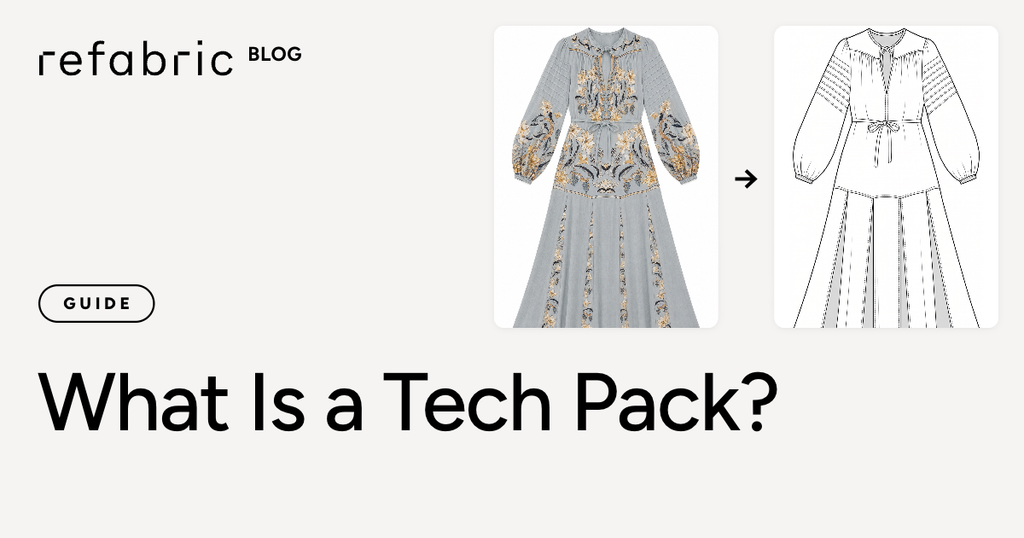
If a factory has ever replied to your sketch with "please send the tech pack," you have already met the answer to the question: what is a tech pack in fashion? A tech pack (short for technical package) is the document that tells a manufacturer exactly how to make a garment. It holds the drawings, materials, measurements, construction details, colors, labels and costs for one style, in a format a pattern maker, a sourcing team and a sewing line can all read.
Think of it as the instruction manual for a product that doesn't exist yet. A mood board says how a piece should feel. A tech pack says how wide the hem is, which zipper goes in, where the logo sits and what the care label reads.
Why factories ask for a tech pack
A factory quotes, samples and produces from what it is given. When the information is vague, someone fills the gap with a guess, and the guess shows up in the sample.
A good tech pack does three jobs:
- It makes quotes comparable. Two suppliers pricing the same detailed document are pricing the same garment.
- It makes samples predictable. Each sample round checks the spec instead of reinventing it, which is why sampling is one of the first places a weak document gets expensive (more on that in our piece on the sampling process).
- It becomes the record. When a bulk order arrives with the wrong trim, the tech pack is what everyone checks against.
What is included in a tech pack
Formats vary by brand and category, but most tech packs answer the same questions in roughly the same order. Here is each part and the question it answers for the factory.
Technical flat sketches
What does it look like, exactly? Flats are clean, proportional line drawings of the garment, front and back, usually without a body or shading. They show seams, darts, pockets, topstitching and closures. A fashion illustration sells a mood; a flat removes ambiguity.
Bill of materials
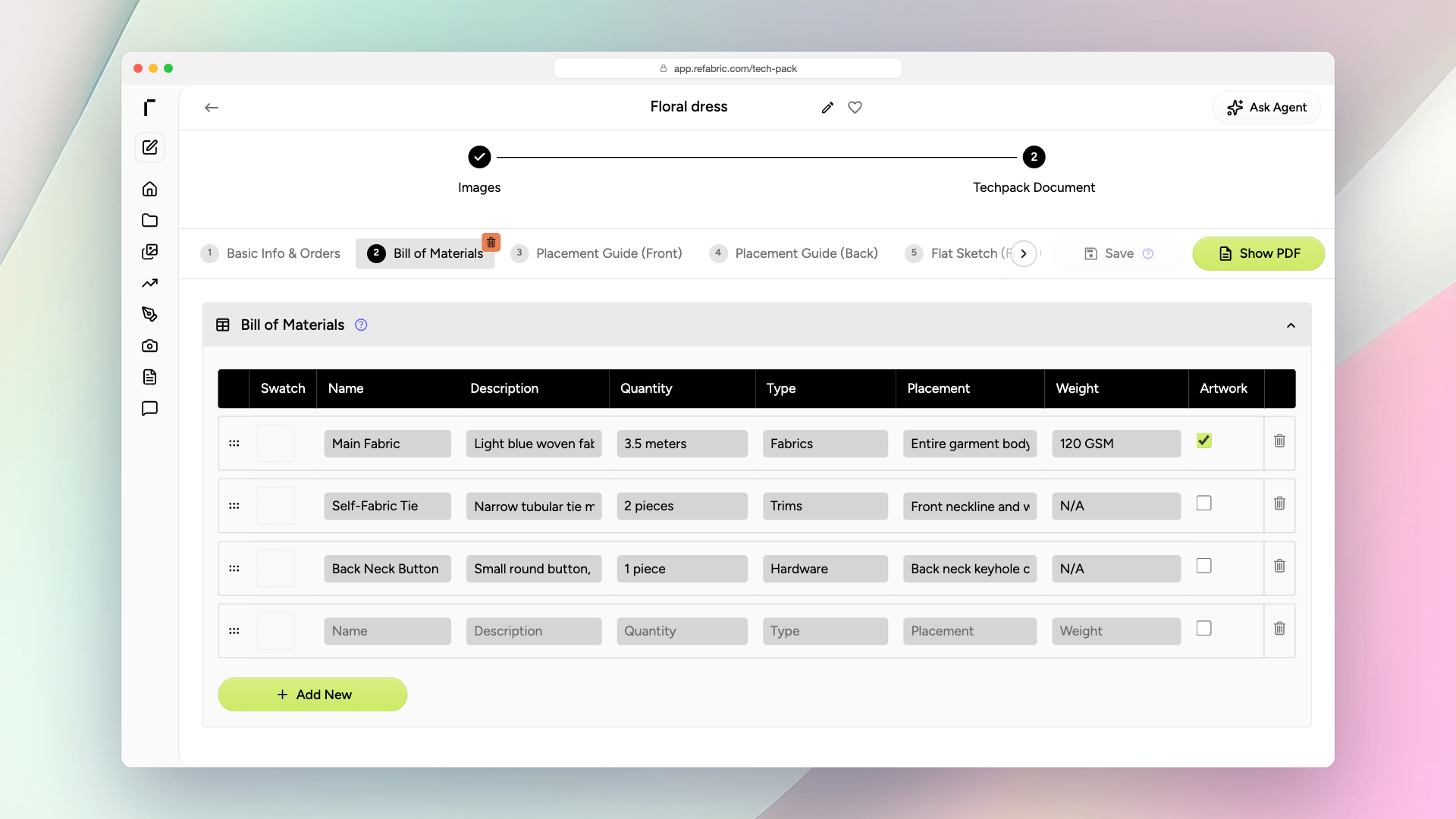
What goes into it? The bill of materials (BOM) lists every component: main fabric, lining, interfacing, thread, buttons, zippers, elastic, labels and packaging. For each line you give the description, fabric composition and weight, color, supplier or reference if you have one, where it is used and how much goes into one garment.
Measurement chart and grading
How big is it, in every size? The measurement chart (also called a spec sheet or size chart) lists each point of measure, such as chest width, waist, body length from the high point shoulder and sleeve length, for the base sample size. Grading rules then say how each point changes from size to size, and a tolerance says how far a finished garment can deviate before it fails inspection.
Construction details and callouts
How is it put together? Callouts point at specific parts of the flat: seam types, stitch types, seam allowances, how the hem is finished, how the pocket is attached. Pattern details often live here too; if you are curious how patterns themselves are being drafted today, see AI in clothing pattern creation.
Colorways, artwork and placement
What color is it, and where does the print go? A color sheet lists each colorway with its color references. Artwork pages hold print files, embroidery and logos, and placement guides show the position and size of each one on the front and back of the garment.
Labels, care and packaging
What does the customer see on the inside? This covers the brand label, size label, care label and any hang tags, plus folding and bagging instructions. Care instructions are not optional decoration: in the US, the FTC's Care Labeling Rule requires care instructions on textile apparel labels, so the tech pack should state them precisely.
Costing
What should it cost to make? A cost sheet breaks the garment down into materials, trims and labor (often called CMT: cut, make and trim). It lets you check a supplier's quote line by line instead of accepting a single number.
How a tech pack moves through product development
A tech pack is not written once and filed. It changes alongside the product:
- Design hand-off. The designer turns the approved sketch into flats, a first BOM and a base-size spec.
- Quoting. The document goes to one or more suppliers, who price it and flag anything they can't source.
- Proto sample. The factory makes a first sample. Fit comments, measurement corrections and construction changes are written back into the tech pack.
- Fit and size set. Graded measurements are confirmed across the size range.
- Pre-production approval. The final version, with every comment resolved, becomes the reference for bulk.
- Production and inspection. Quality control measures finished pieces against the spec and its tolerances.
Keep a version number and a date on every revision. "Which version did you sample from?" is a question you want a quick answer to.
Common tech pack mistakes
- Missing tolerances. Without them, any measurement is technically acceptable, and no one can reject a sample.
- One view only. A front flat with no back view leaves the back neck, yoke and closures to interpretation.
- Vague materials. "Cotton, light blue" could be a dozen fabrics. Give composition, weight and a reference.
- Trims without quantities. If the BOM says "buttons" but not how many and where, expect a question, or a surprise.
- Out-of-date files. Comments from the last sample live in an email thread instead of the document.
- No care or label details. These are easy to forget and slow to fix once labels are printed.
How long does it take to make a tech pack?
It depends on the garment and on what you already have. A basic tee with a known block is quick to document; a lined jacket with custom trims, prints and a full size range takes much longer, because every component has to be specified and every point of measure graded.
The slow parts are usually the flats, the BOM and the measurement chart. The work also doesn't end at the first version: each sample round adds corrections. Building the document from a template, starting from an existing style's spec and keeping a single shared file all cut down the back-and-forth.
How Refabric builds a tech pack from a product image
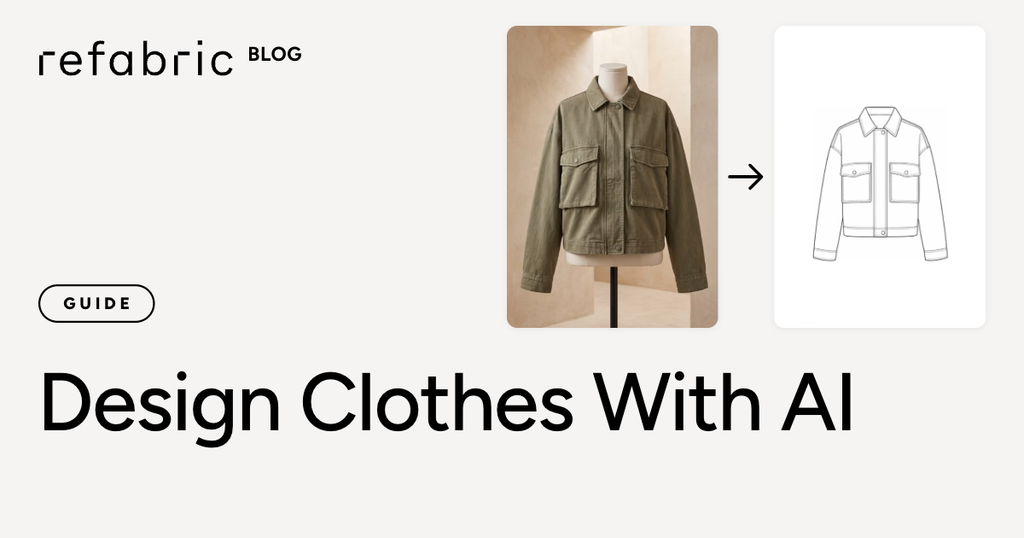
The steps above assume you start from a blank page. Refabric's AI Tech Packs start from a picture instead: you upload front and back product images, and it returns a fully structured tech pack, with no flat sketch and no manual input required.
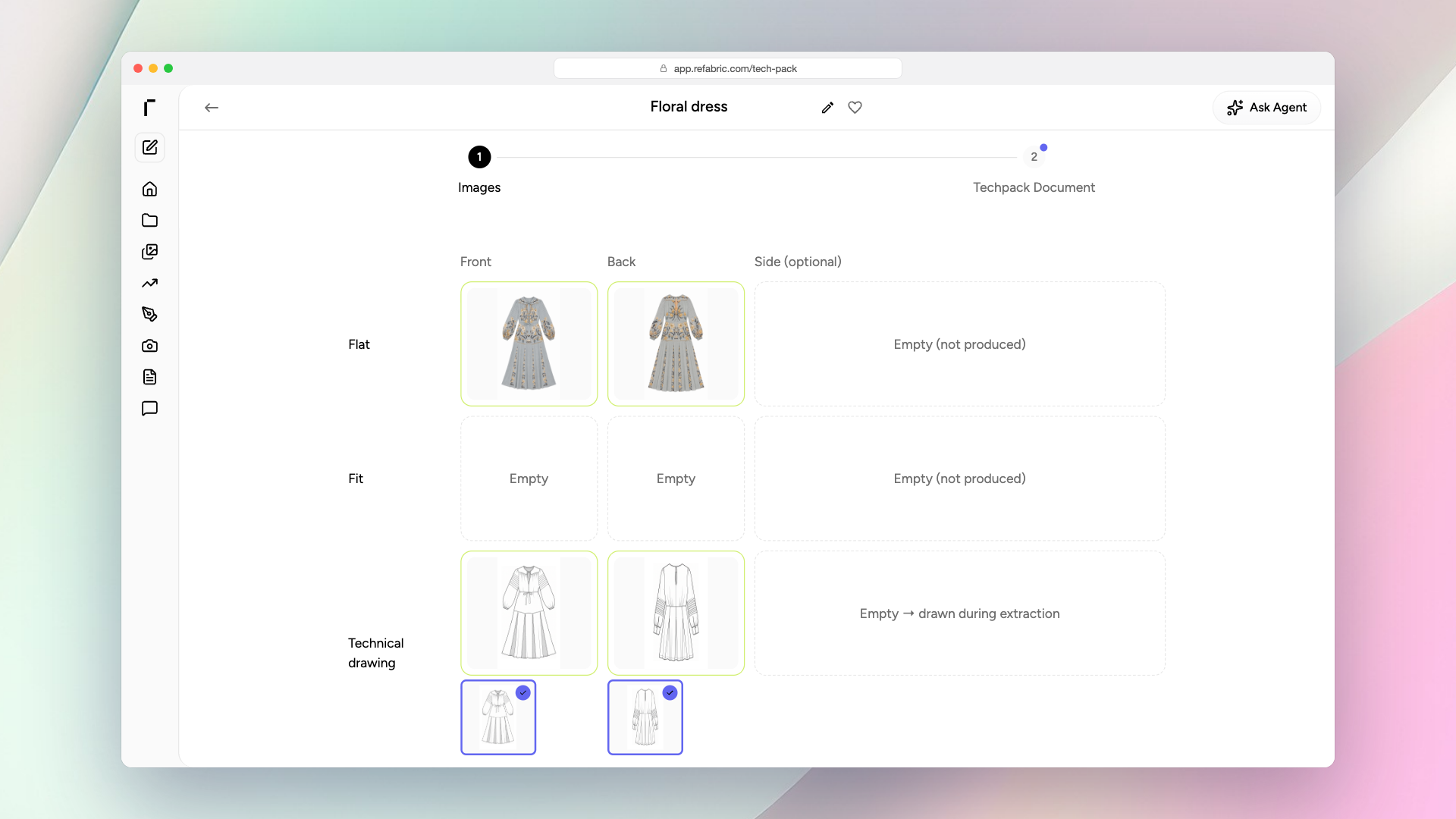
The document follows the same structure a factory expects: Basic Info & Orders, Bill of Materials, Placement Guide (front and back), Flat Sketch (front and back), Pattern Block, Size Chart, Fabrics, Trims, Color Sheet, Cost Sheet and Care Instructions.
- Flats are drawn front and back in four style options (Standard, Technical, No Print, Textured), in full color or black and white.
- The bill of materials is filled in from the image: fabric composition, GSM weight, trim specifications, hardware details and quantity per garment.
- The size chart is auto-graded from 2XS to XL, with grade increments and tolerances per point of measure.
Before anything is sampled, a 3D view rendered from the tech pack data lets the team review silhouette, proportion and construction, and Production Intelligence flags construction complexity and potential manufacturability issues and suggests fabric alternatives. Every field stays editable, so you check and correct the draft the way you would review any first version. When it's ready, you export it as SVG, Excel or a PDF and send it to your supplier.
FAQ
Do I need a tech pack to work with a clothing manufacturer?
Most manufacturers expect one before they quote or sample. Some full-package factories will develop it for you from a sketch or a reference garment, but you then depend on their interpretation. Having your own tech pack keeps the specification in your hands and makes quotes from different suppliers comparable.
What is the difference between a tech pack and a spec sheet?
A spec sheet usually means the measurement chart: points of measure, sizes, grading and tolerances. A tech pack is the complete package that contains the spec sheet alongside flat sketches, the bill of materials, construction callouts, colorways, artwork placement, labels, care instructions and costing for the same style.
Can I make a tech pack without technical drawing skills?
Yes. Many designers start from a template and a reference garment, or work with a freelance technical designer for the flats and grading. Tools that generate flats and a first draft from product images also help, as long as you review every measurement and material before it goes to the factory.

The Refabric team writes about how fashion brands design, develop and produce collections — tech packs, sampling, product photography — and where AI helps. Every article is reviewed by the team before it is published.
Design it, cost it and shoot it in one place.
Start free, or book a demo and we'll walk you through it.
More in How to
View all →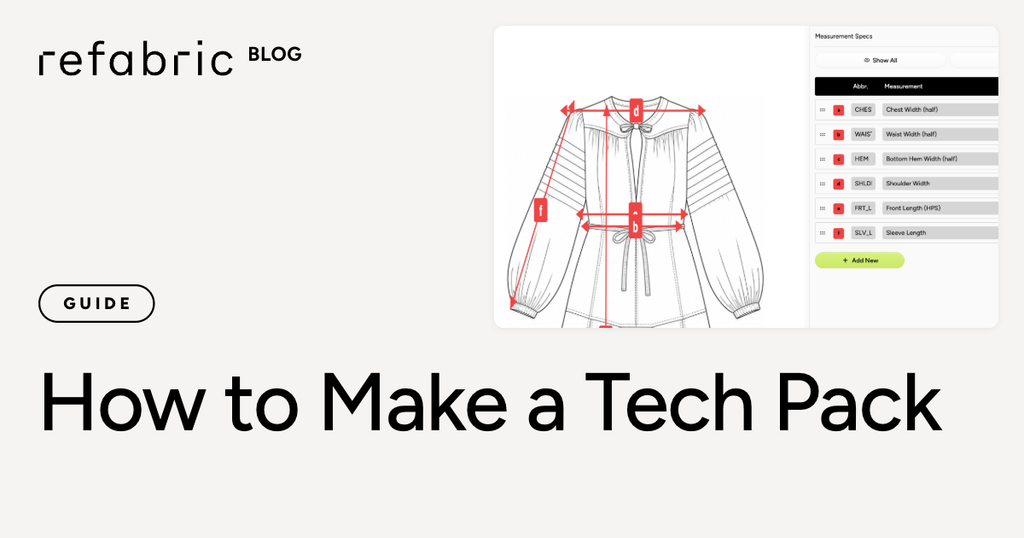
How to Make a Tech Pack: A Step-by-Step Guide for Factories
By Refabric Editorial TeamNovember 25, 20269 min read
How to Design Clothes With AI: A Step-by-Step Guide
By Refabric Editorial TeamNovember 25, 20269 min read

How Fashion AI Helps to Design the Perfect Ugly Christmas Sweater
By AI Fashion Design AssistantDecember 9, 20243 min read